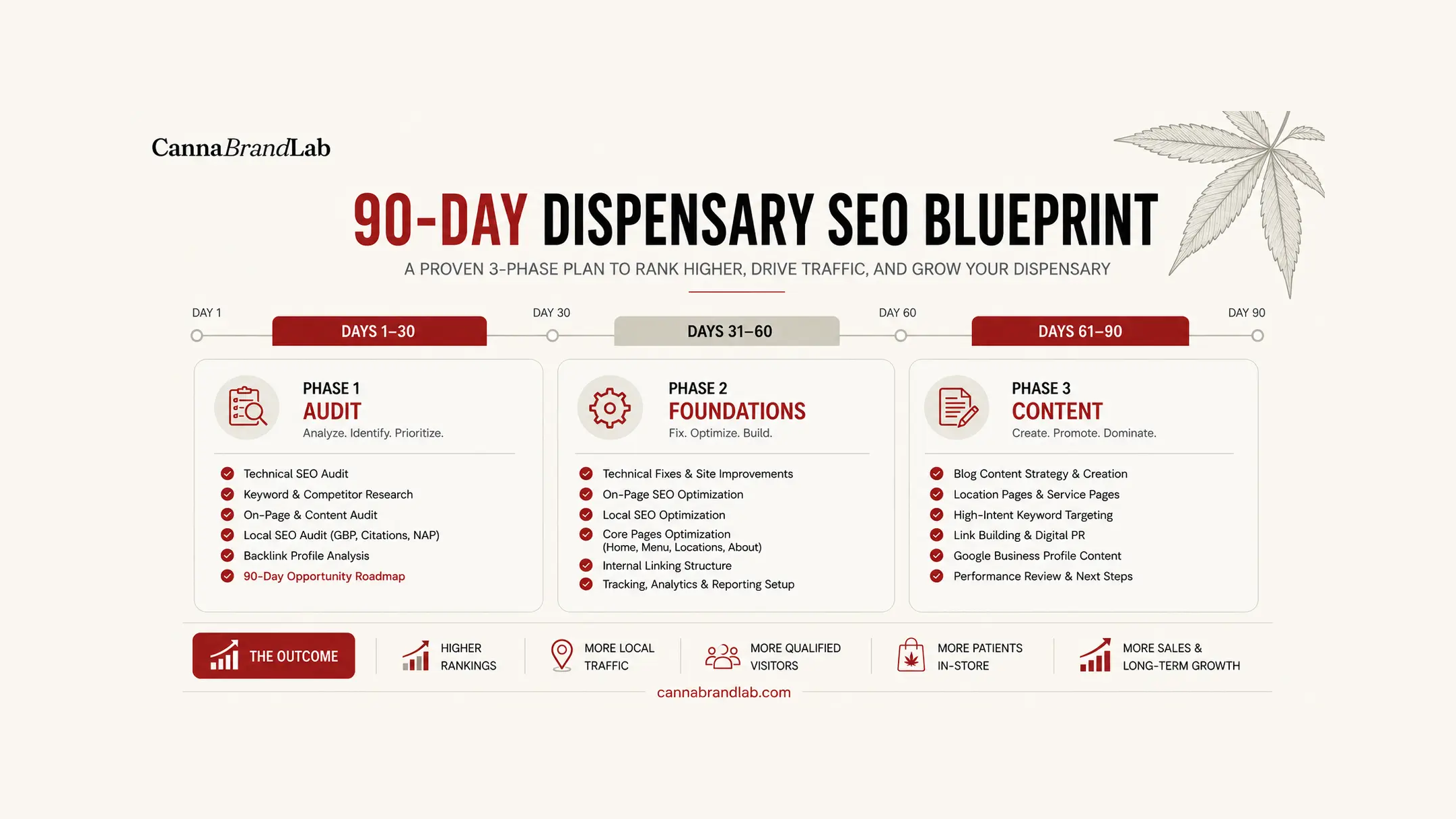
Dispensary SEO is the work of making your store the answer when someone nearby searches for cannabis. In the map pack, on your menu pages, and in the question results. This blueprint sequences that work into 90 days of ordered moves, ranked by effort against impact, current as of June 2026.
Sequenced is the operative word. There are plenty of dispensary SEO guides ranking right now, and most are lists. Fifteen tips, twelve strategies, floating in no particular order, as if “start a blog” and “fix your Google Business Profile” deserve the same week. They don’t. Order is most of the strategy. Doing the right things in the wrong sequence produces the activity of SEO without the revenue.
One disclosure before we start, because it frames everything: we sell SEO services and nothing else. No menu software, no POS, no loyalty platform. That matters more than it sounds like it should, and the next section is about why.
Read this first: who wrote your last SEO guide
Look at who ranks for dispensary SEO advice. A point-of-sale company. A menu platform. A loyalty software vendor. Another menu platform. Four of the top ten results for this exact search are written by companies whose product is the embedded menu on your website.
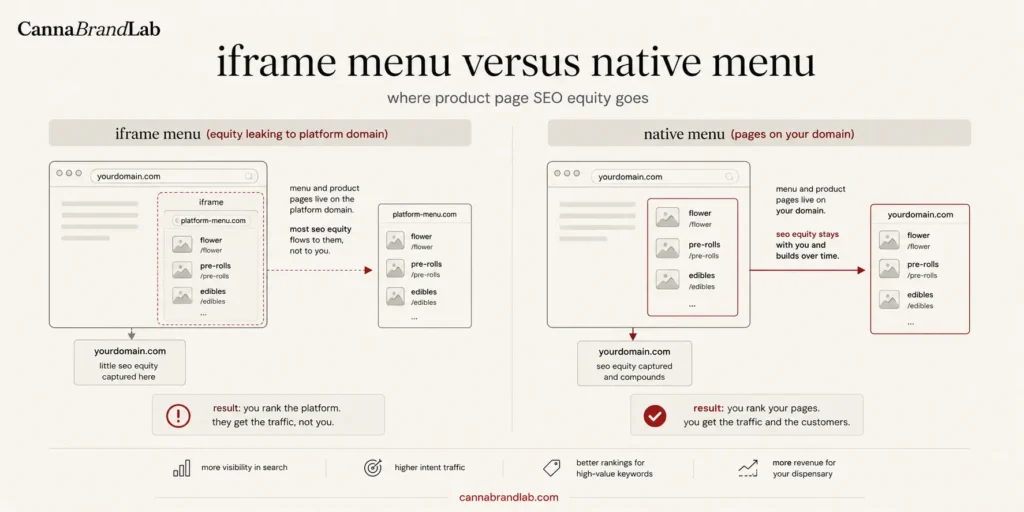
Here’s the structural problem. The single highest-impact technical issue in dispensary SEO (the one worth more than every blogging tip combined) is that iframe menus keep your product pages off your own domain. A menu vendor’s SEO guide cannot lead with that, because the fix is either their premium API product or their competitor. So their guides talk about blogging. Lots of blogging.
This isn’t an accusation of bad faith, it’s an observation about incentives, and you should apply it to us too. We sell SEO, so we think SEO matters.
The difference is our conflict is printed at the top of the page. Adjust accordingly.
Days 1-14: the audit and the hygiene
Nothing in week one is clever. All of it compounds.
Google Business Profile to actual completeness. Primary category: Cannabis store. Hours exact. “open now” is a search filter, and a wrong closing time is a refund you issue in trust. Products section populated. Real photos of your actual store. Attributes filled. This is an afternoon, and it outranks months of blogging.
The NAP sweep. Name, address, phone. Identical on Weedmaps, Leafly, Yelp, Apple Maps, and the directory pages you forgot exist. Mismatches read as unreliability to Google’s local systems. Tedious, mechanical, done once, maintained quarterly.
The iframe check. View your menu page’s source. Search for “iframe.” If you find one, every product on your menu lives on someone else’s domain, and you’ve located the ceiling on everything else in this blueprint. You don’t have to fix it in week one. You do have to know.
Noindex the junk. Tag archives, the sample page, “uncategorized,” parameter URLs. A WordPress install ships with index pollution by default. We found an uncategorized archive indexed on our own site recently, so consider this advice pre-humbled. If your rankings feel stuck despite good content, the diagnostic usually starts here. We wrote up the common failure patterns separately.
Days 15-45: the map pack offensive
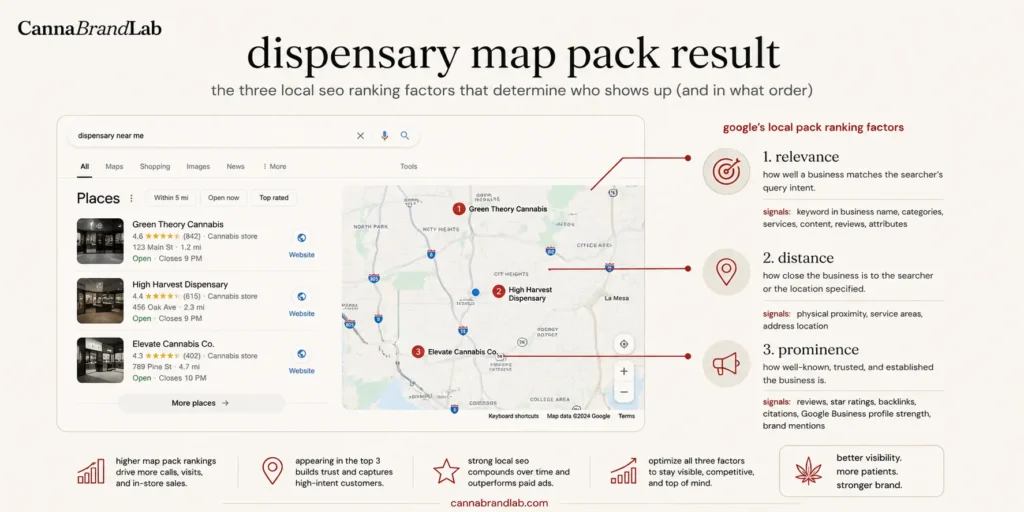
The map pack is where dispensary revenue lives, because the searcher is in a car. Three local listings, three inputs: relevance, distance, prominence. Distance is fixed. The other two are the campaign.
| Move | Effort | Impact | Cadence |
|---|---|---|---|
| Review velocity (ask at counter, QR on receipt) | Low | High | Daily habit |
| Owner responses to every review | Low | Medium-high | Weekly hour |
| One real page per location | Medium | High | Once, then maintain |
| GBP posts for drops and deals | Low | Medium | Weekly |
| Local citations and sponsorship links | Medium | Medium | Monthly |
| Photos refreshed seasonally | Low | Low-medium | Quarterly |
Two of those rows deserve sentences. Reviews: steady beats spike. Twenty real ones a month outperforms two hundred bought ones, and the bought batch eventually gets the listing suspended. Your budtenders generate review-asks forty times a day just by answering questions; the retail playbook is mostly writing down trust that already exists at your counter.
Location pages: each store gets its own page with address, embedded map, hours, parking, what’s nearby. The details only someone who’s stood in your parking lot would know. Boilerplate with a swapped city name doesn’t count. Google can tell. So can the customer.
Days 30-60: the menu decision
Back to the iframe you found in week two.
The decision: keep the embedded menu and accept that strain and product searches will never land on your site, or move to a native menu. Product pages rendered on your domain through your platform’s API, with product schema. The native route costs real money and a real project. It is also the difference between owning a thousand indexable pages and renting a brochure.
The question to ask your menu platform, verbatim: “Do my product pages render on my domain, server-side, with product schema, and can Googlebot see them without executing your JavaScript?” Then watch the answer carefully.
“We’re SEO-friendly” is not a yes. A yes is a yes.
If the budget says not this quarter, the interim play: build real category landing pages you own. “indica flower in [your city]” can rank on your domain even while the cart lives in the iframe, and route the menu link through them. Partial ownership beats none, and the pages transfer when you eventually migrate.
Days 45-90: content with jobs
Now content, in its correct position: after the foundation, never instead of it.
Ten pages, each with a named job. For most single-market dispensaries the first ten look like: one page per location (done in phase two), your state’s legality and purchase-limit explainer, a first-visit FAQ, two or three neighborhood pages for the districts customers drive from, and product-education pages matched to what your counter staff explain most. Effects and dosing content stays educational. One promise-shaped sentence about sleep or anxiety is an FDA letter with your logo on it.
Every page targets one search, links to one next step, and exists because a customer asked the question out loud at some point. If you can’t name the search a page serves, the page is decoration. Pick targets where difficulty is under 10 (dispensary terms are full of them) and resist the urge to chase “dispensary near me” with a blog post; that search belongs to the map pack you’re already building.
The 90-day scorecard
What should have moved by day 90, measured in Search Console and your Business Profile insights rather than by feel: direction requests and calls up against the prior 90; map-pack position for your core “[city] dispensary” terms tracked weekly; ten pages indexed and at least half on page one for their long-tail targets; menu decision made, even if the migration is scheduled rather than shipped.
What won’t have moved: competitive head terms. That’s year-one work, and anyone who promised otherwise was selling weather. When we ran this sequence for a multi-door operator, the early wins were exactly the boring ones (completeness, locations, reviews) and the compounding showed up in the quarters after. The dispensary chain case study shows the shape of it.
If day 90 arrives and nothing moved, the diagnosis is almost always one of three: the iframe stayed, the reviews stalled, or the pages got jobs they couldn’t win. Re-audit in that order.
After day 90
The blueprint becomes a cadence. Weekly: reviews and responses. Monthly: one new page with a job, one earned local mention. Quarterly: NAP sweep, keyword re-validation, photo refresh. Call it six hours a month of disciplined maintenance, and it compounds while your competitors rotate between bursts of enthusiasm and quarters of nothing. Anyway, that’s the whole program. The rest is just doing it.
Whether you run it yourself or hire it out is an honest fork. One or two locations with a careful manager and ten real weekly hours: run it yourself, this page is the manual. Technical migration, brutal market, or multiple states: that’s what we do, and the audit comes with the dollar logic attached. What we’d fix, in what order, why. Fifteen minutes tells you which fork you’re on. We’ll say so either way; we’ve turned down retainers that should have been a checklist, and we’d like to keep the streak.
FAQ
What is dispensary SEO?
Dispensary SEO is the practice of earning visibility in Google’s local map pack, organic results, and AI answers for searches that lead to cannabis purchases. “dispensary near me,” strain and product terms, and legality questions. With paid ads largely prohibited for cannabis retail, it’s the primary owned acquisition channel.
How long does dispensary SEO take to show results?
Map-pack movement from profile and review work typically shows in 60-90 days. Long-tail content pages can rank in their first quarter. Competitive head terms take six to twelve months. Any faster promise is describing either a tiny market or a lie.
How much does dispensary SEO cost?
Done in-house, the first 90 days costs hours, not dollars. Roughly ten a week. Agency retainers for dispensary SEO credibly run $2,000–$7,000 monthly depending on locations and market; menu re-platforming projects price separately. Cheaper usually means a reseller running a checklist you could run yourself.
Can my dispensary rank without fixing the iframe menu?
In the map pack and for informational searches, yes. For strain and product searches, no. Iframe menu content credits the platform’s domain, not yours. You can defer the fix and still win local; you can’t skip it and win product search.
Is SEO better than Weedmaps or Leafly for dispensaries?
They’re different line items. Directories rent you placement in their audience; SEO builds visibility you own. Most dispensaries need directory presence for the citation value alone, but the long-term margin lives in searches that land on your own domain instead of a marketplace showing your competitors alongside you.
What’s the most important ranking factor for the dispensary map pack?
No single factor, but the controllable cluster is profile completeness, review velocity with owner responses, and a real location page per store. Distance you can’t change. Prominence you build weekly. Most dispensaries lose on completeness, which is the easiest input on the list.
Can dispensaries do SEO for delivery service areas?
Yes. Service-area pages for delivery zones work like location pages: one real page per zone with genuine local detail, delivery times, and minimums. Don’t fake storefronts in cities you deliver to; Google suspends listings for that, and the suspension outlasts the gain.
Should a dispensary blog every week?
No. Ten pages with jobs beat fifty posts without them. Publish when a page has a search to win and a next step to link, for most single-market stores that’s monthly after the first ten, not weekly. Frequency is a vendor metric, not a Google one.
Do dispensary SEO keywords differ by state?
The structure repeats; the terms and rules don’t. Med-only states search “dispensary” with card-related modifiers, rec states search product-first, and each state’s marketing rules constrain what your pages can say. State-specific legality pages are among the highest-converting content a dispensary can publish.
Can I run dispensary SEO and skip Google ads entirely?
You mostly don’t have the choice. Google Ads prohibits THC retail promotion in the US, which is exactly why this channel matters. The limited paid lanes (some CBD, programmatic networks) are supplements. For plant-touching retail, organic local search isn’t an alternative channel; it’s the channel.